Impact
""
The impact of the war and the limited capacity of local authorities weakened the relationship between the Local Water and Sanitation Corporation and residents in the neighborhoods of Taiz City that receive a relatively regular water supply. This weakened relationship led residents to stop paying water bills, which the Corporation had not issued in previous years. During the early years of the war, amid the difficult circumstances facing residents and the widespread theft of water meters, many residents in neighborhoods receiving water removed their meters to protect them from being stolen.
Recently, with support from Sheba Youth Foundation for Development, the Local Water and Sanitation Corporation restored part of its operational capacity, helping it improve the organization of its work. However, the suspension of water billing had left the Corporation operating without revenue. This prompted its management to consider resuming the issuance of water bills for neighborhoods receiving a regular water supply. However, the prevailing circumstances led residents to reject both the payment of water bills and the reinstallation of water meters.
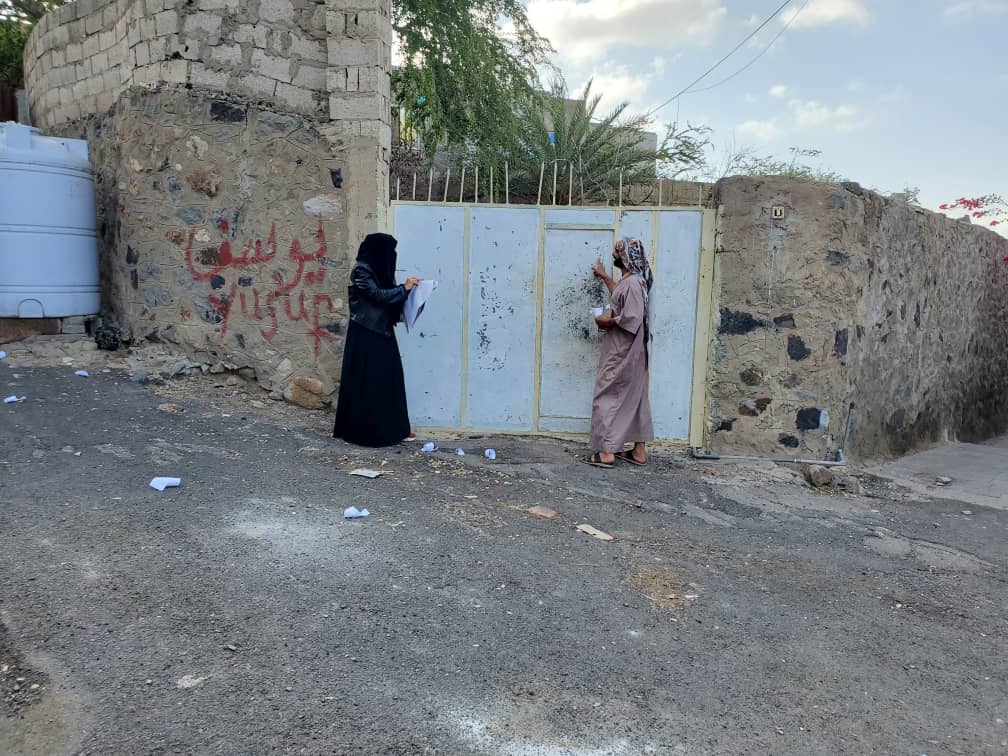
As part of the activities of the Sanad 2 Project for Strengthening Community Stability, implemented by Sheba Youth Foundation for Development with funding from Jusoor Program, Sheba Youth Foundation for Development, in partnership with the Sanad Network, implemented an awareness campaign targeting three residential neighborhoods that receive a regular water supply: Al-Masabih, the Old City, and Al-Jumhouri. The campaign aimed to encourage residents to install water meters, pay their bills, and adopt more responsible water consumption practices.
Ghazza Yahya, a Sanad Network member and activist, emphasized the importance of the initiative, saying: “People need awareness-raising efforts that reconnect them with development and ultimately encourage them to take part in efforts to restore public services, starting with water.”
The awareness campaign targeted both men and women in the selected areas and included gender-sensitive messages to ensure that gender considerations were integrated throughout all project activities.
The campaign included door-to-door awareness-raising activities for residents, as well as the printing and distribution of 1,000 awareness-raising brochures and 500 awareness posters across the three targeted neighborhoods.
Fatima Saeed, a woman in her forties who lives in Al-Masabih neighborhood, said: “We had almost forgotten that there was a water corporation, meters, and bills. But as long as they are going to restore our water supply, we will certainly reinstall the meter and pay our bills on time.”
In addition to the field awareness activities, the Foundation, through the Sanad Network established by the project, conducted a digital awareness campaign that included the publication of 100 awareness posts, the production and dissemination of three short awareness videos, and 20 awareness posters.